NASA’s BioNutrients-2 Produces Fresh Vitamins on ISS Using Engineered Yeast
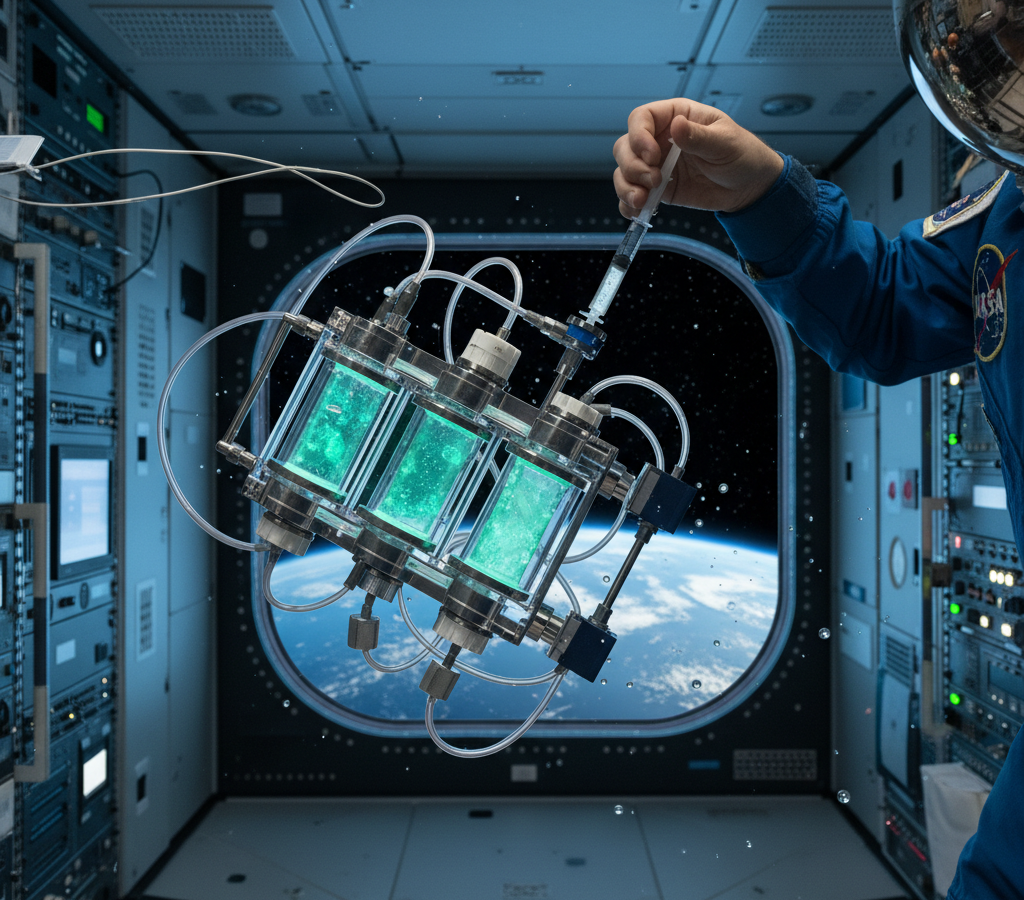
NASA successfully demonstrated on-demand vitamin production aboard the International Space Station using genetically engineered yeast. The BioNutrients-2 experiment generated fresh beta-carotene, zeaxanthin, and folate during a three-month mission, addressing nutritional degradation challenges that complicate long-duration space exploration.
The Vitamin Problem in Space
Extended space missions face a fundamental challenge: vitamins degrade over time. Studies show that vitamin C levels in stored food decline 50% within 12 months even under optimal storage conditions. Vitamin A, folate, and other essential nutrients similarly deteriorate, with degradation accelerating under radiation exposure.
Mars missions lasting 30-36 months cannot rely on pre-packaged food without risking nutritional deficiencies. Resupply missions from Earth are impractical given 6-9 month transit times. Growing fresh vegetables in space provides some nutrients but cannot supply fat-soluble vitamins or many essential compounds in sufficient quantities.
NASA’s solution: engineer microorganisms to produce vitamins on demand from simple sugar feedstocks that remain stable for years.
Synthetic Biology in Microgravity
The BioNutrients-2 payload contained freeze-dried Saccharomyces cerevisiae (baker’s yeast) engineered with biosynthetic pathways to produce three essential nutrients:
- Beta-carotene (Vitamin A precursor): Inserted genes from bacteria Pantoea ananatis producing enzymes that convert the yeast’s native mevalonate pathway into beta-carotene.
- Zeaxanthin (carotenoid for eye health): Extended beta-carotene pathway with additional hydroxylation steps.
- Folate (Vitamin B9): Enhanced native yeast folate synthesis through overexpression of key enzymes GTP cyclohydrolase and pteridine synthase.
Astronauts rehydrated the freeze-dried yeast with sugar solution, incubated at 30°C for 72 hours, then separated and purified the nutrients using miniaturized chromatography cartridges. The entire process occurred within a shoebox-sized automated device requiring minimal crew intervention.
Performance Results
Three production runs aboard the ISS between October and December 2024 demonstrated:
- Beta-carotene: 1.8 mg per batch (sufficient for 2 daily doses). Concentration: 92% of ground control experiments.
- Zeaxanthin: 0.8 mg per batch (4 daily doses). Concentration: 87% of ground control.
- Folate: 420 micrograms per batch (1 daily dose). Concentration: 96% of ground control.
The slight reduction versus ground experiments likely stems from microgravity effects on yeast metabolism and gas exchange in fermentation chambers. However, yields remained sufficient for practical nutritional supplementation.
Microbial contamination—a major concern in enclosed spacecraft environments—remained below detection limits. Genetic stability analysis showed no mutations in engineered pathways despite cosmic radiation exposure, confirming the yeast strains’ reliability for long missions.
Advantages Over Traditional Approaches
Compared to alternative nutritional strategies, engineered yeast offer several advantages:
- Storage stability: Freeze-dried yeast remains viable for 5+ years at room temperature versus 12-18 months for packaged vitamins.
- Mass efficiency: 20 grams of freeze-dried yeast plus sugar produces same vitamins as 400 grams of packaged supplements (20:1 mass savings).
- Freshness: Nutrients produced immediately before consumption, eliminating degradation concerns.
- Flexibility: Can engineer yeast for additional nutrients as mission requirements evolve.
- Psychological benefit: Astronauts report higher satisfaction with “freshly produced” nutrients versus consuming degraded rations.
Scaling to Long-Duration Missions
Mars mission planning assumes crew of 6 astronauts for 900 days (30 months). Daily nutritional requirements include:
- Vitamin A: 900 micrograms (3 mg beta-carotene)
- Folate: 400 micrograms
- 10+ additional vitamins and essential compounds
Extrapolating from BioNutrients-2 performance, a Mars mission would require:
- 12 kg freeze-dried engineered yeast (30-month supply for 6 crew)
- 180 kg sugar feedstock
- 6 automated production devices (redundancy for failures)
- Total mass: 220 kg versus 1,400 kg for equivalent packaged vitamins
The 84% mass savings translates to $2.2 million in reduced launch costs at current $20,000/kg SpaceX Starship rates. For NASA’s Artemis lunar base (continuous 4-person occupation), savings exceed $8 million over 5 years.
Expanding Nutritional Capabilities
BioNutrients-3, scheduled for ISS deployment in 2026, will expand production capabilities to include:
- Vitamin K2: Essential for bone health, particularly important in microgravity where bone loss averages 1.5% per month
- Astaxanthin: Powerful antioxidant protecting against cosmic radiation damage
- Essential amino acids: Methionine and lysine to supplement plant-based diets
- Omega-3 fatty acids: EPA and DHA for cardiovascular and cognitive health
Researchers are also engineering Spirulina (cyanobacteria) as backup production chassis. Spirulina offers advantages including photosynthetic growth (reducing sugar requirements) and inherently high protein content. However, taste challenges remain—astronaut feedback from preliminary tests: “Nutritious but unpleasant.”
Terrestrial Applications
While developed for space, the technology has Earth-based applications:
- Military field operations: Special forces units deploy for months without resupply access. Compact vitamin production systems reduce logistics burden.
- Disaster relief: Natural disasters disrupt supply chains. On-site nutrient production from shelf-stable inputs enables sustained operations.
- Remote research stations: Antarctic and Arctic research bases face supply challenges similar to space missions.
- Developing regions: Areas with limited cold chain infrastructure could benefit from shelf-stable nutrient production systems.
Commercial interest is emerging. Supplement manufacturer NOW Foods is evaluating licensing the technology for consumer products—imagine home vitamin brewing similar to yogurt making.
Biosafety and Regulatory Considerations
Using genetically modified organisms in enclosed environments raises safety concerns NASA addressed through multiple containment levels:
- Physical containment: Production occurs in sealed devices with HEPA filtration preventing yeast escape.
- Biological containment: Engineered yeast carry auxotrophic mutations requiring supplementation of amino acids not present on spacecraft, preventing survival outside production chambers.
- Genetic safeguards: Nutrient biosynthesis genes are chromosomally integrated (not on mobile plasmids) preventing horizontal gene transfer.
FDA approved the technology for space use in 2023 under regulations governing closed environment food production. Terrestrial commercial applications would require standard GMO food additive approvals—a well-established regulatory pathway given that insulin, chymosin (cheese enzyme), and many food additives already use GMO production.
Future: Closed-Loop Life Support
BioNutrients represents one component of NASA’s vision for closed-loop life support systems enabling permanent space settlement. Future integration includes:
- Coupling vitamin-producing yeast with waste recycling systems (using crew waste as nitrogen source)
- Integrating with hydroponic vegetable production (yeast CO2 feeds plants, plant waste feeds yeast)
- Developing multi-organism consortia for complete nutritional requirements
- Engineering microbes to produce pharmaceuticals on-demand for medical emergencies
“We’re building the biological infrastructure for space civilization,” notes Dr. John Hogan, BioNutrients principal investigator. “Every organism we successfully adapt to space brings us closer to true self-sufficiency beyond Earth.”
As humanity expands into the solar system, synthetic biology will prove as essential as rockets and spacesuits. The ability to produce complex organic compounds from simple inputs using engineered organisms transforms space exploration from supply-chain-dependent expeditions to sustainable settlements capable of thriving indefinitely off-world.