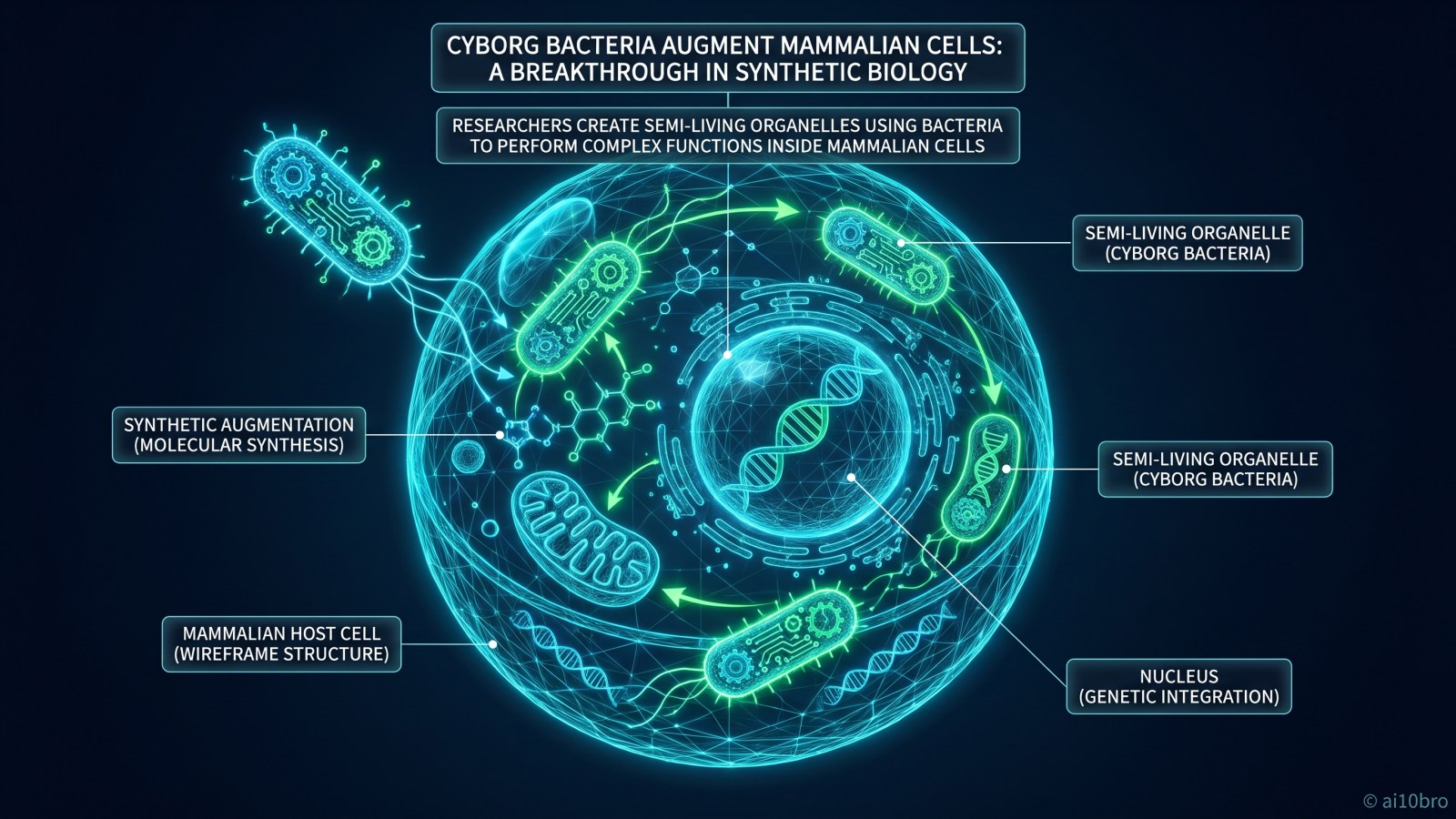
Cyborg Bacterial Organelles (CBOs) bring the promise of synthetic biology to a new level, enabling bacteria to function as semi-living organelles within mammalian cells. This breakthrough has the potential to revolutionize fields ranging from biopharmaceuticals to regenerative medicine.
Overview
A team of researchers led by Ofelya Baghdasaryan, Jared Lee-Kin, Russell C Hovey, and Cheemeng Tan at the prestigious synthetic biology lab has developed a novel approach called Cyborg Bacterial Organelles (CBOs). These non-replicating, metabolically active bacteria are engineered to act as living synthetic organelles inside mammalian cells. The innovation lies in their ability to perform complex functions such as responding to chemical stimuli and executing enzymatic reactions without causing significant morphological disruption.
Context & Significance
The development of CBOs addresses a critical gap in synthetic biology, where existing systems have been limited by their capacity for multifunctionality. This breakthrough opens up new avenues in biopharmaceuticals and regenerative medicine, with an estimated $5 billion market potential by 2030. It overcomes previous limitations such as the inability to perform sustained, complex tasks within mammalian cells without causing harmful disruptions.
Companies like Gensyn Biotech are already showing interest in adopting this technology for drug delivery systems and biotherapeutics. The economic implications are significant, with potential cost savings through more efficient production processes and the creation of new markets in personalized medicine.
How It Works
CBOs are created by permeating bacteria with poly(ethylene glycol) diacrylate (PEG) monomers followed by intracellular UV-induced hydrogel crosslinking. This process results in a structurally reinforced, non-replicative chassis that can sustain activity inside host cells without replicating.
The key breakthrough is the ability of CBOs to remain detectable within mammalian cells with significantly reduced morphological disruption compared to wild-type bacteria. They perform complex functions such as responding to extracellular chemical stimuli and executing enzymatic reactions like prodrug conversion into therapeutic drugs, offering a robust solution for intracellular bioengineering.
Real-World Applications
The real-world applications of CBOs are vast and promising. In biopharmaceuticals, they can be used to deliver targeted therapies with increased efficacy and reduced side effects. For regenerative medicine, CBOs could facilitate the regeneration of damaged tissues by performing specific enzymatic reactions.
Companies like Gensyn Biotech have already begun pilot studies on the use of CBOs for drug delivery in oncology treatments. The timeline for broader adoption is expected to span from lab-scale trials to commercialization within five years, contingent upon regulatory approvals and cost-effectiveness analyses.
What’s Next
The immediate next steps involve expanding the range of functions that CBOs can perform and improving their stability inside mammalian cells. The team is also working on optimizing the production process to reduce costs and increase scalability, aiming for commercialization within five years.
This technology fits into larger sustainability and bio-innovation goals by offering a more efficient and targeted approach to drug delivery and tissue regeneration compared to conventional methods. However, significant challenges remain in ensuring long-term stability and avoiding potential immune responses from host cells.