Hooks
The researchers from the University of Zurich have introduced a new framework called BiPert, which significantly advances our ability to predict and identify genetic perturbations in cellular behavior. This innovative approach could revolutionize how we understand gene function and regulatory mechanisms at scale.
Overview
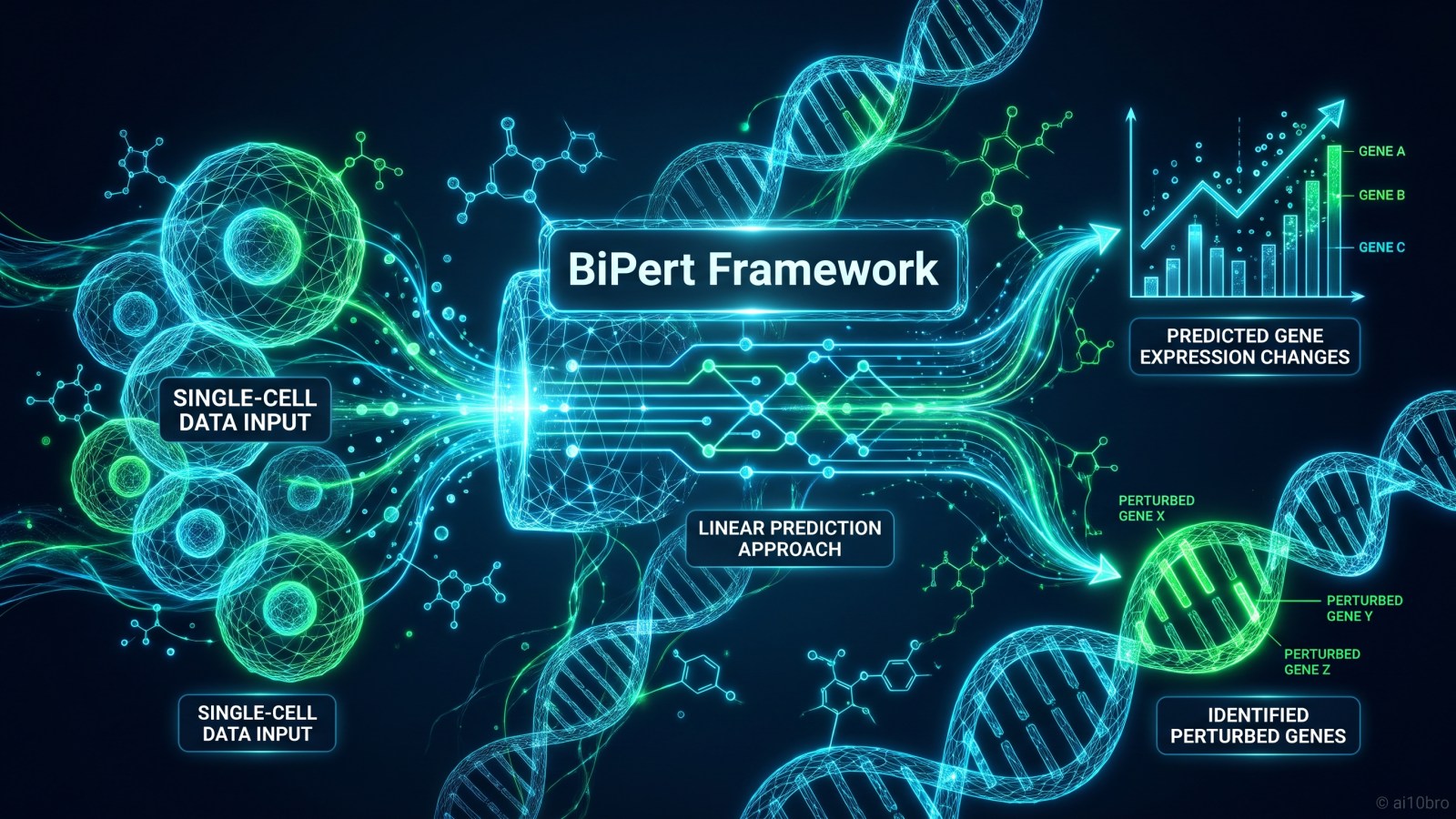
In their recent publication, Abhishek Sharma and Aleksej Zelezniak from the University of Zurich present BiPert, a unified linear framework for modeling single-cell perturbations. This tool outperforms existing methods in predicting gene expression changes across different cell lines without requiring extensive external biological knowledge. Additionally, its few-shot extension, BiPert-FS, can adapt to new cell types with as few as ten measured perturbations. The inverse identification component, BiPert-ID, surpasses deep-learning approaches in identifying genes from single-cell transcriptional profiles.
Context & Significance
The significance of this research extends far beyond academic interest. With the global gene therapy market expected to reach $35 billion by 2030, tools that can predict and identify genetic perturbations with greater accuracy are crucial for advancing personalized medicine and targeted therapies. BiPert addresses a key limitation in current methodologies: the inability to accurately model unseen cell types and donors. This breakthrough could accelerate drug discovery processes and reduce development costs.
How It Works
The BiPert framework leverages linear decomposition, breaking down transcriptional responses into shared and perturbation-specific components. For forward prediction, this approach outperforms existing methods that do not utilize external biological knowledge by accurately predicting gene expression changes in unseen cell lines. BiPert-FS extends this capability with a few-shot learning mechanism, adapting to new contexts using minimal data. The inverse identification component, BiPert-ID, identifies perturbed genes from single-cell expression profiles more effectively than deep-learning methods.
Key innovations include:
- A unified linear framework for both forward and inverse tasks
- The ability to predict gene expression changes in unseen cell lines with high accuracy
- Few-shot learning capability, enabling adaptation with minimal data
This approach is distinct from prior work because it emphasizes simplicity and interpretability over complex models. By focusing on linear decomposition, BiPert provides a strong baseline for predicting and identifying genetic perturbations.
Real-World Applications
The commercial potential of BiPert is substantial. Pharmaceutical companies like Novartis and Amgen could leverage this framework to accelerate their drug discovery pipelines, reducing the time and cost associated with identifying gene targets for new therapies. Biotech startups focused on personalized medicine might also adopt BiPert as a core component in their proprietary algorithms.
BiPert’s scalability is evident through its potential to move from lab experiments to pilot programs within two years. Full commercialization could follow, integrating this technology into existing workflows and driving significant cost savings for the industry.
What’s Next
The immediate next steps involve scaling up BiPert’s application in real-world scenarios, such as clinical trials and drug discovery pipelines. Researchers are also exploring how to further enhance the few-shot learning capabilities of BiPert-FS for broader applicability.
Commercialization timelines depend on regulatory approvals and validation studies. While this framework offers significant potential benefits, challenges remain in fully integrating it into existing biotech workflows without disrupting established processes.