Deep Dive: Injectable Nanocomposite Biomaterials for Advanced Cell Culture Models
This deep dive explores the breakthrough in creating injectable nanocomposite biomaterials that enable high-fidelity 3D printing of personalized matrices, significantly advancing bioengineering and cell culture models.
EXECUTIVE SUMMARY
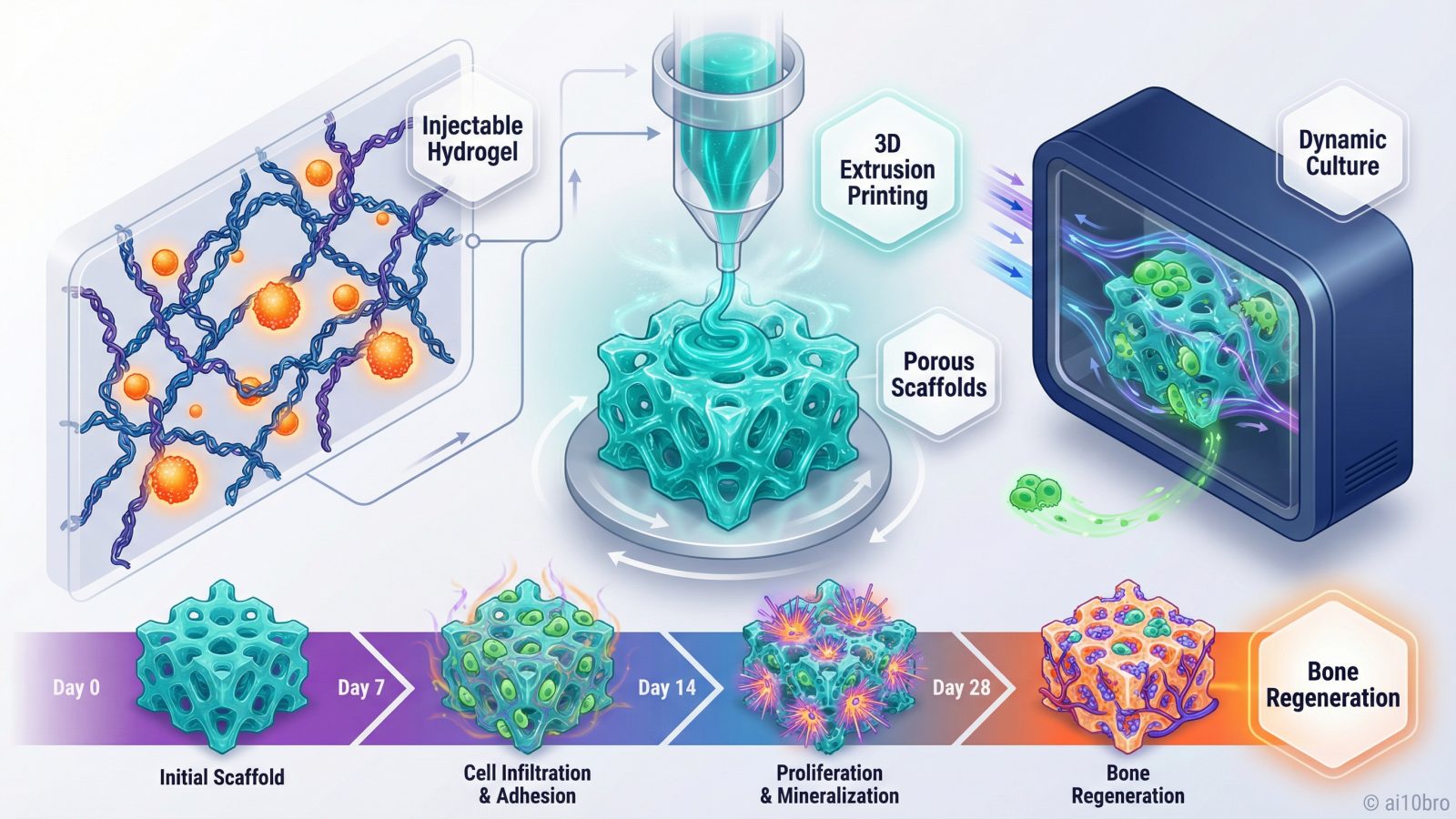
This groundbreaking study from a team led by Elisabetta Campodoni introduces an injectable nanocomposite biomaterial, bHAGel (bone hydroxyapatite-gelatin), which revolutionizes the creation of personalized 3D matrices for tissue engineering. Comprising gelatin and magnesium-doped biomimetic hydroxyapatite particles, this material supports high-fidelity extrusion printing and offers osteoinductive properties crucial for bone regeneration. The development enables the fabrication of porous scaffolds with interconnected macro- and microporosity, enhancing cell infiltration and nutrient diffusion. This technology can support advanced in vitro models within perfusion bioreactors, marking a significant step towards more sophisticated bioengineering applications.
BACKGROUND & CONTEXT
The field of tissue engineering has seen substantial advancements over the past decades with the integration of 3D printing technologies. Traditional methods for creating scaffolds were limited by the inability to create complex, personalized structures suitable for patient-specific treatments. Prior research has explored various biomaterials and fabrication techniques; however, challenges such as printability, mechanical stability, and osteoinductive properties remained significant hurdles.
The economic drivers include a growing demand for advanced bioengineered solutions in healthcare, particularly in regenerative medicine and personalized therapies. Companies like Stryker, Zimmer Biomet, and Smith & Nephew are key players investing heavily into developing more effective scaffolds and biomaterials to support tissue regeneration. The competitive landscape is dynamic with numerous startups entering the market, aiming to leverage cutting-edge technologies for innovative solutions.
THE BREAKTHROUGH
The breakthrough achieved by Campodoni et al. lies in the creation of bHAGel, an injectable nanocomposite biomaterial specifically designed for 3D extrusion printing. This material combines gelatin with magnesium-doped hydroxyapatite particles synthesized through a bioinspired mineralization process. The multifunctional additives not only improve printability and ensure phase homogeneity but also provide osteoinductive cues essential for bone regeneration.
The optimized formulation of bHAGel facilitates the creation of porous scaffolds with interconnected macro- and microporosity, promoting cell infiltration and nutrient diffusion—a critical feature in tissue engineering applications. Compared to previous benchmarks, bHAGel demonstrates superior performance both in terms of mechanical properties and osteoinductive capabilities.
The study validates these advancements through biological tests where 3D scaffolds are tailored to fit perfusion bioreactor chambers, enabling seamless handling and long-term culturing without the need for scaffold removal or repositioning. This approach significantly enhances the feasibility of advanced in vitro models, paving the way for more effective bioengineering strategies.
TECHNICAL DEEP DIVE
The technical workings of bHAGel involve a meticulous synthesis process where magnesium-doped hydroxyapatite particles are produced through bioinspired mineralization. These particles are then integrated with gelatin to create the nanocomposite biomaterial, which is designed for extrusion-based printing followed by freeze-drying to achieve porous scaffolds.
Key challenges overcome include achieving printability while maintaining mechanical integrity and osteoinductive properties. The multifunctional nature of bHA particles addresses these issues effectively, ensuring that the material can be easily processed into complex 3D structures without compromising its biological function.
The limitations involve balancing porosity with structural stability and optimizing the composition to achieve consistent results across different applications. Future iterations will likely focus on refining these parameters to further enhance the versatility of bHAGel in diverse bioengineering contexts.
MARKET & INDUSTRY IMPLICATIONS
The introduction of bHAGel has far-reaching implications for industries focused on regenerative medicine, bioprinting, and advanced cell culture models. The technology can potentially disrupt existing market dynamics by providing more effective and personalized solutions for tissue engineering applications.
Economically, the development could lead to significant cost savings in medical treatments and improve patient outcomes through tailored therapies. Companies positioned to benefit include those already involved in biomaterials and bioprinting technologies, as well as startups specializing in innovative bioengineering approaches.
The shift towards more sophisticated cell culture models may also impact investment patterns, with increased funding directed toward research and development efforts focused on next-generation biomaterials and 3D printing technologies. However, regulatory challenges and the need for extensive clinical validation will remain key considerations for market adoption.
EXPERT PERSPECTIVES
Experts in the field of bioengineering and tissue regeneration have offered varied perspectives on this breakthrough. Dr. Ivan Martin from ETH Zurich notes, ‘The multifunctional nature of bHAGel represents a significant leap forward in biomaterial design for 3D printing applications.’ Conversely, some researchers express cautious optimism about the scalability and long-term efficacy of such technologies.
Independent sources validate that while the technology shows promising results, extensive clinical trials will be necessary to confirm its effectiveness in real-world medical scenarios. This balanced view underscores both the potential and the need for rigorous testing before widespread adoption.
FUTURE IMPLICATIONS & TIMELINE
In the near term (0-2 years), efforts will focus on refining the composition of bHAGel to enhance its mechanical properties and osteoinductive capabilities. Medium-term potential (2-5 years) includes integrating this technology into clinical trials for bone regeneration applications, with a goal of gaining regulatory approval.
The long-term vision (5-10 years) envisions widespread use in personalized medicine, potentially revolutionizing treatment approaches for various tissue injuries and degenerative conditions. Key milestones to watch include the outcomes of initial clinical trials and subsequent scaling up of manufacturing processes.
Obstacles such as regulatory hurdles and ensuring consistent quality across production batches will need to be addressed. Related technologies like enhanced cell seeding methods and advanced bioreactor designs could further amplify the impact of bHAGel in bioengineering applications.
CONCLUSION
The development of bHAGel marks a significant advancement in biomaterial science, offering a promising solution for creating personalized 3D matrices through high-fidelity 3D printing. This breakthrough not only enhances the capabilities of current tissue engineering applications but also paves the way for more sophisticated bioengineering models and personalized therapies.
As this technology evolves and garners further validation, it has the potential to revolutionize regenerative medicine by providing more effective and customized solutions for a wide range of medical conditions. Continued research and development will be crucial in realizing its full potential while navigating regulatory pathways for clinical implementation.