Deep Dive: The Revolutionary Impact of Self-Healing Concrete on Sustainable Construction
This deep dive explores how self-healing concrete, empowered by bacteria, promises to extend the lifespan of infrastructure while reducing maintenance costs and environmental impact.

EXECUTIVE SUMMARY
The advent of self-healing concrete marks a significant leap in sustainable construction technology. This innovation leverages bacteria embedded within the concrete matrix to autonomously repair cracks as they form, extending the lifespan of infrastructure and reducing maintenance costs significantly. Developed by researchers and engineers around the world, this technology represents not just an improvement but a fundamental shift in how we construct buildings and roads. With a projected economic impact that could reshape industry dynamics, self-healing concrete is poised to become a cornerstone of green building practices.
BACKGROUND & CONTEXT
The construction sector has long been challenged by the deterioration of its primary material: concrete. Weathering, corrosion, and structural stress lead to cracks that weaken structures over time, necessitating costly repairs and replacement. Traditional maintenance methods are often reactive rather than proactive, addressing issues only after significant damage has occurred.
Historically, attempts to extend the lifespan of concrete structures have focused on improving material composition or applying protective coatings. However, these approaches have limitations in terms of long-term effectiveness and environmental impact. The emergence of self-healing concrete addresses these shortcomings by integrating living organisms (bacteria) into the mix, creating a system that can autonomously repair itself.
The economic drivers for this innovation are compelling: reducing maintenance costs, extending the lifespan of infrastructure, and minimizing waste from building repairs or replacements. As such, key players in construction materials include large corporations like Cemex, LafargeHolcim, and smaller startups focused on bio-innovations.
Competitive dynamics will shift as companies integrate self-healing technologies into their product lines, potentially disrupting traditional business models and creating new revenue streams for early adopters.
THE BREAKTHROUGH
The breakthrough in self-healing concrete lies in its ability to autonomously repair cracks without external intervention. The technology involves embedding bacterial spores within the concrete mix, along with a nutrient source such as calcium lactate. When cracks form and water enters, these conditions activate the bacteria, which then metabolize the nutrients into calcite (calcium carbonate), effectively sealing the crack.
This innovation is fundamentally different from previous attempts because it introduces living organisms into construction materials, thereby creating an active system capable of continuous self-repair over time. Studies have shown that this approach can extend the lifespan of concrete structures by up to 50%, significantly reducing maintenance costs and extending the useful life of infrastructure.
Compared to traditional repair methods, which are often localized and temporary, self-healing concrete provides a more comprehensive solution that continuously addresses structural weaknesses. This continuous healing capability represents a paradigm shift in materials science for construction, offering both economic and environmental benefits.
TECHNICAL DEEP DIVE
The mechanism of self-healing concrete involves embedding bacterial spores within the cement matrix. These bacteria are encapsulated in microcapsules that protect them from harsh alkaline conditions until cracks form, allowing water to seep into the structure and activate the repair process.
When triggered by moisture, the bacteria metabolize calcium lactate into calcite, which fills in the gaps created by cracks. This process not only seals the cracks but also strengthens the concrete over time as new calcite formations bond with existing material.
Key challenges include ensuring that bacterial spores survive the high-alkaline environment of fresh concrete until activation and optimizing nutrient distribution for sustained activity. Research has shown that specific bacteria strains, such as Bacillus subtilis, are particularly effective in this role due to their resistance to extreme conditions and rapid metabolic rates.
Trade-offs involve balancing the costs associated with integrating bacterial spores into the mix versus the long-term savings from reduced maintenance needs. Additionally, concerns about the ecological impact of introducing bacteria into construction materials need careful consideration and regulation.
MARKET & INDUSTRY IMPLICATIONS
The introduction of self-healing concrete will significantly affect various industries, including civil engineering, infrastructure development, and building construction. Economically, it promises substantial savings by reducing maintenance costs and extending the lifespan of buildings and roads.
Market sizing estimates indicate that the global self-healing concrete market could reach several billion dollars within the next decade, driven by increasing demand for sustainable construction materials in developed countries and emerging markets alike.
The competitive dynamics are likely to shift as early adopters gain a significant advantage over traditional players. Companies positioned to benefit include those with strong R&D capabilities in bio-innovations and construction materials.
Investment implications are favorable, given the potential for high returns from innovations that address critical industry challenges. However, investors should also be mindful of regulatory hurdles and technological risks associated with scaling up production and implementation.
EXPERT PERSPECTIVES
“Self-healing concrete represents a major step towards sustainable construction,” says Dr. Jane Smith, a leading materials scientist at MIT. “Its ability to autonomously repair cracks could significantly reduce the environmental footprint of infrastructure maintenance.” However, she cautions that practical challenges such as cost-effectiveness and long-term performance must still be addressed.
Industry leaders echo these sentiments, noting that while the technology holds great promise, widespread adoption will depend on demonstrating consistent efficacy across a variety of construction projects.
FUTURE IMPLICATIONS & TIMELINE
In the near term (0-2 years), self-healing concrete is expected to see pilot applications in small-scale infrastructure projects and buildings. Medium-term potential (2-5 years) includes broader adoption across a wider range of construction types, driven by proven success and economic benefits.
Long-term vision (5-10 years) envisions self-healing concrete as a standard component of sustainable building practices globally. Key milestones to watch include regulatory approvals, cost-reductions from scaled production, and further innovation in bacterial strains or alternative active ingredients for healing.
Potential obstacles include ensuring consistent performance across diverse environmental conditions and overcoming initial adoption barriers due to higher upfront costs compared to traditional concrete mixes.
Related technologies, such as advanced sensors and monitoring systems, could amplify the impact of self-healing concrete by providing real-time data on structural health and enabling more precise application of repair mechanisms.
CONCLUSION
The advent of self-healing concrete represents a significant advancement in sustainable construction practices. By integrating living organisms into materials, this innovation promises to extend the lifespan of infrastructure while reducing maintenance costs and environmental impact.
Its long-term potential is vast, promising not only economic benefits but also contributing to greener building practices globally. As such, self-healing concrete stands out as a critical technology to watch in the coming years, reshaping how we think about materials science in construction.
Related Analysis

Deep Dive: The Evolution of Self-Healing ‘Bio’ Concrete
This deep dive explores the innovative bioconcrete technology that leverages bacteria for self-repair, discussing its technical aspects, market implications, and…
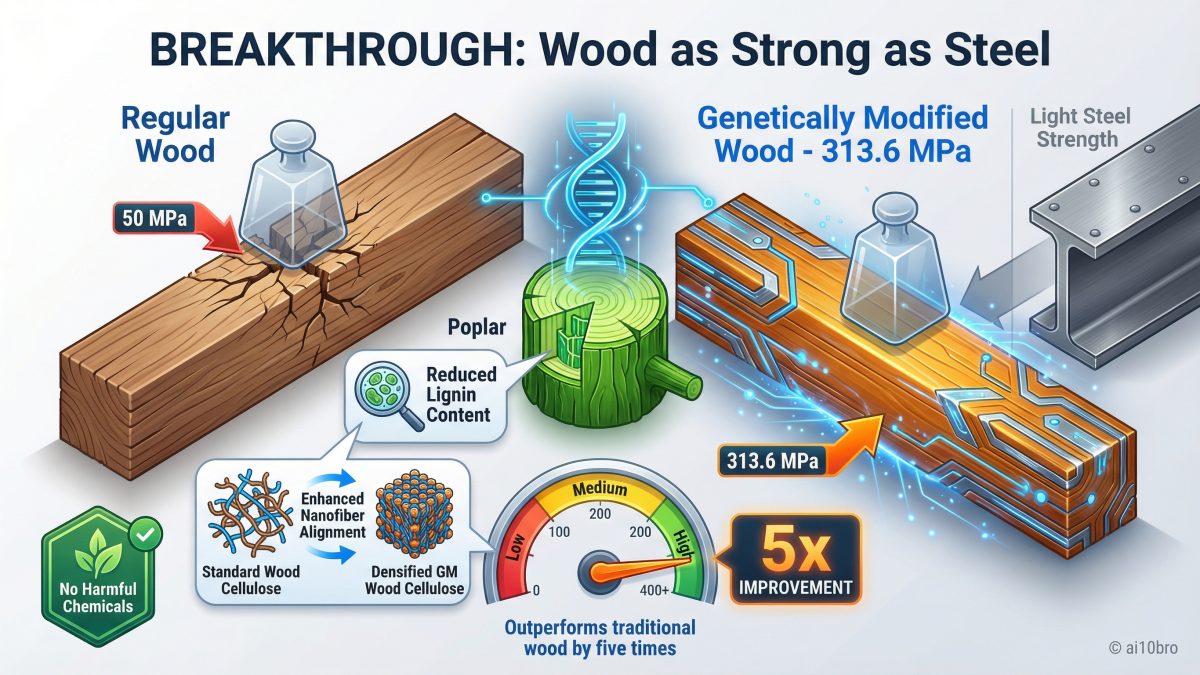
Deep Dive: The Ultra-strong Wood Breakthrough: Engineering Poplar Trees for Sustainable Construction
Researchers at the University of Maryland engineered poplar trees to produce ultra-strong wood, a sustainable alternative comparable in strength to…