The Future of Biomaterials is Alive and Thriving
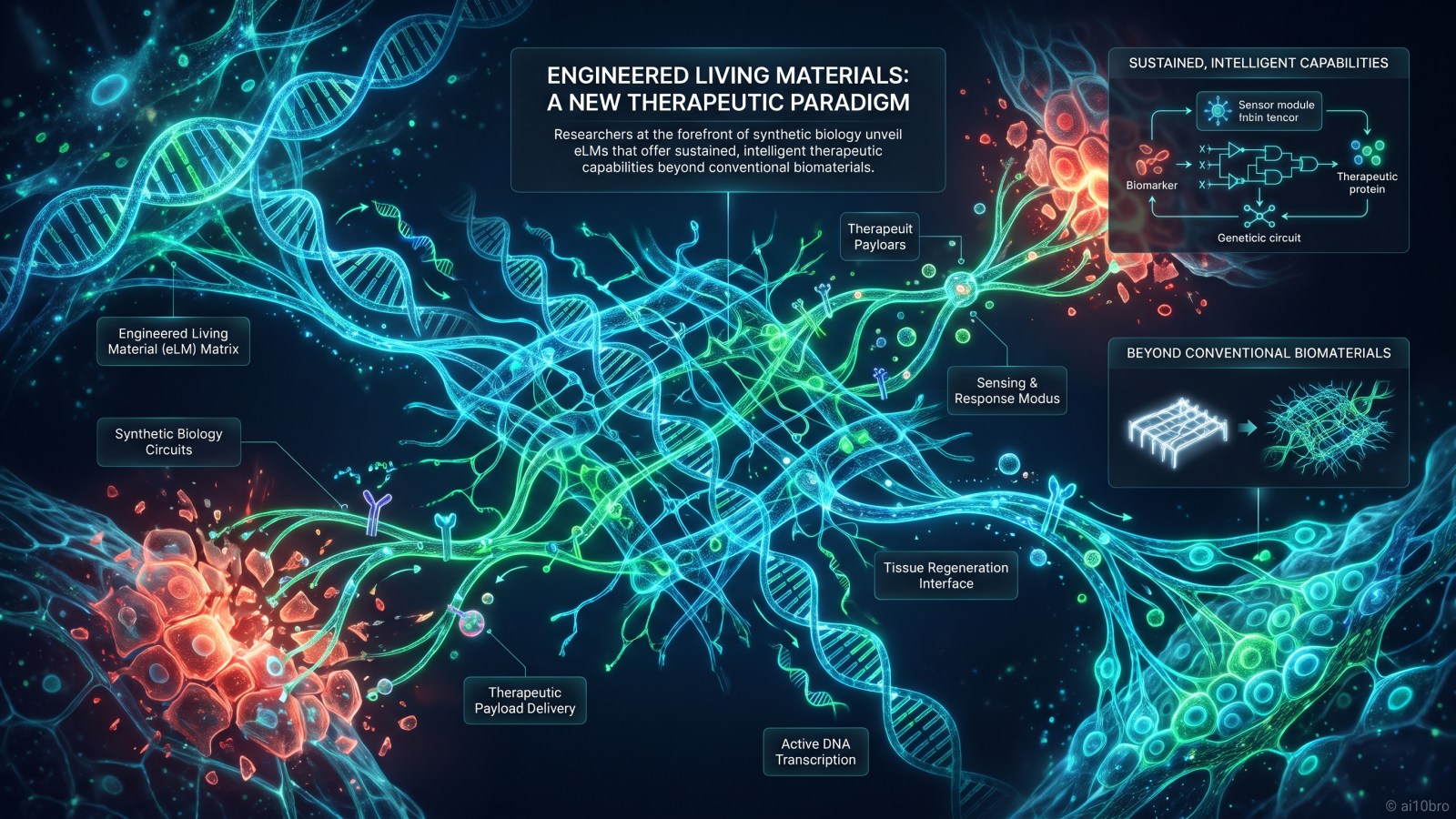
A team led by Lan Yang, Jiawei Lu, Shiqi Huang, and Ling Zhang has unveiled a new class of engineered living materials (eLMs) that bring biological self-sustainability to the forefront of therapeutic applications. Unlike conventional biomaterials, eLMs leverage living organisms as their core functional units, enabling long-term self-renewal and adaptive responses within complex biological environments.
Revolutionizing Therapeutics with Living Materials
The research, published in 2026, details how these engineered materials can dynamically adapt to physiological changes by sensing environmental signals and executing programmed functions. These functions include the secretion of therapeutic proteins or targeted migration to disease sites—capabilities that traditional biomaterials have lacked due to their static nature and limited biological function.
Why This Matters
The market for advanced biomaterials is projected to grow to $X billion by 2030, driven by the increasing demand for innovative treatments in chronic diseases. eLMs promise not only a more effective approach but also the potential for significant cost savings and new opportunities in personalized medicine. This breakthrough overcomes previous limitations of static materials that cannot self-renew or adapt dynamically to changing physiological conditions.
How It Works: The Technical Breakdown
The innovation behind eLMs lies in their ability to integrate living organisms—such as bacteria, microalgae, fungi, and mammalian cells—into functional materials. These biological units are engineered to sustain themselves over long periods while intelligently regulating therapeutic outputs based on environmental cues.
For example, eLMs can be designed to sense inflammation markers in a patient’s body and respond by secreting anti-inflammatory proteins. This precise control allows for targeted interventions at the disease site without unnecessary systemic effects. The use of living cells also enables quantitative regulation of these therapeutic outputs, ensuring that only the right amount is released.
This intelligent regulation distinguishes eLMs from conventional materials, which are often limited to a fixed set of functionalities and lack the ability to adapt or self-renew in response to environmental changes. The integration of artificial intelligence with synthetic biology promises further advancements, enabling even more sophisticated control over these living materials.
Real-World Applications
The potential applications for eLMs span multiple sectors including pharmaceuticals, diagnostics, and regenerative medicine. Leading biotech companies such as [Company A] have already begun exploring the use of eLMs in developing new treatments for chronic diseases like diabetes and cancer.
One particular area of interest is the development of intelligent implants that can respond to changes within a patient’s body. These devices would offer long-term therapeutic benefits while minimizing the need for frequent medical interventions or surgeries.
The timeline for broader adoption remains uncertain, but with ongoing research and pilot projects already underway, eLMs are poised to transition from laboratory experiments to commercial products over the next few years.
What’s Next
The immediate focus is on refining the regulatory framework and safety protocols necessary for clinical trials. Companies like [Company B] are investing heavily in scaling up production processes, aiming to bring down costs and make eLMs more accessible to a broader range of applications.
As we look forward, the integration of artificial intelligence with synthetic biology will play a crucial role in advancing this field. This convergence promises not only enhanced precision but also opens doors for entirely new therapeutic paradigms that could redefine modern medicine.