Mangrove Restoration Project Sequesters Carbon 5X Faster Than Tree Planting
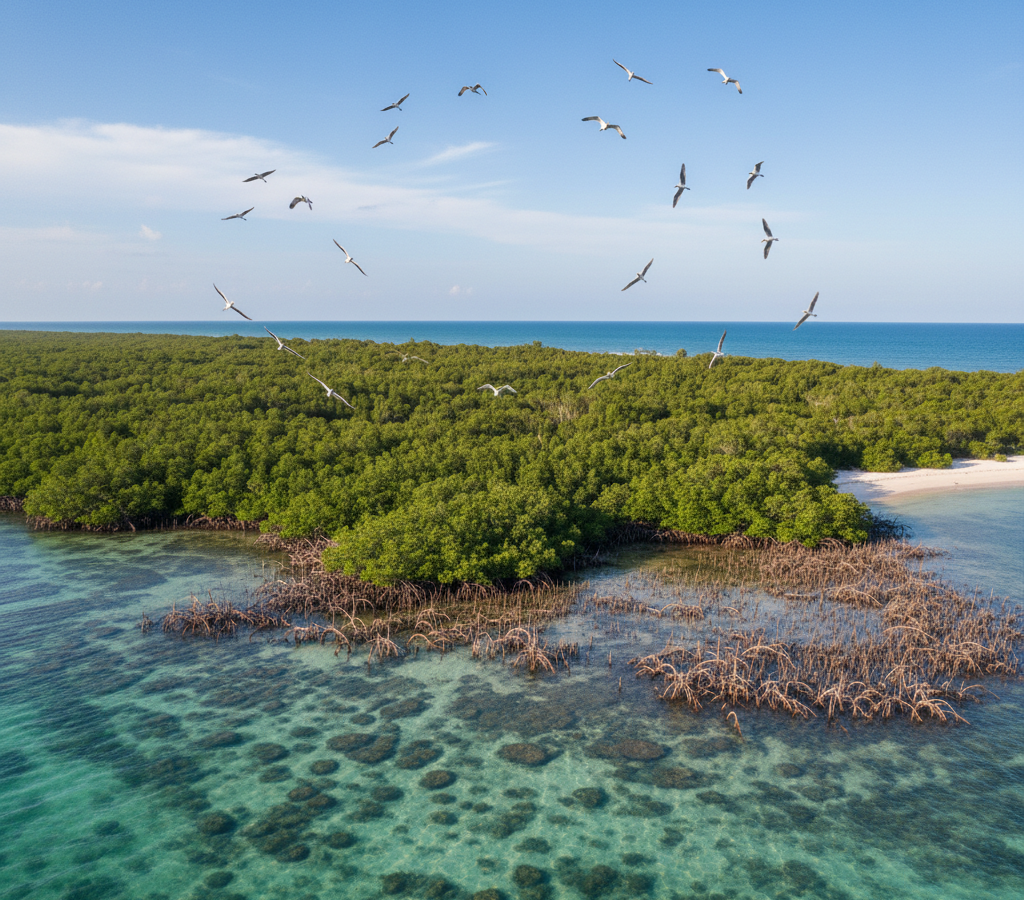
A five-year coastal restoration initiative in Indonesia demonstrates that mangrove reforestation captures carbon five times faster than terrestrial tree planting while providing additional benefits including fishery habitat, storm surge protection, and coastal stabilization. The Blue Forests Coalition’s 12,000-hectare project offers a scalable model for climate mitigation in tropical coastal regions.
Why Mangroves Outperform Forests
Mangroves—salt-tolerant trees growing in coastal intertidal zones—store carbon in both biomass and underlying sediments. Their unique root systems trap organic matter and mineral sediments, creating thick layers of carbon-rich mud that accumulate over centuries.
Per hectare, mangroves sequester 308 tons of carbon in biomass plus 940 tons in sediments (0-1 meter depth) versus 180 tons total for equivalent tropical rainforest. Annual sequestration rates reach 6.2 tons CO2e per hectare—five times the 1.2 tons typical of terrestrial tree planting projects.
“Mangroves are carbon capture and storage systems engineered by evolution,” explains Dr. Maya Sari, the project’s lead ecologist. “They create their own habitat while locking carbon away for millennia.”
Restoration Methodology
The Blue Forests Coalition rejected conventional “planting day” approaches that achieve only 10-20% survival rates. Instead, they implemented hydrological restoration allowing natural regeneration:
- Hydrological reconnection: Removed dikes and excavated channels restoring tidal flow to 12,000 hectares of degraded shrimp ponds and rice paddies.
- Sediment stabilization: Installed biodegradable barriers controlling erosion during establishment phase.
- Natural seed dispersal: Adjacent intact mangrove forests provided seed sources via tidal distribution.
- Community engagement: Partnered with 47 coastal villages, providing alternative livelihoods during restoration period.
This approach achieved 83% mangrove coverage within three years—far exceeding planted projects’ typical outcomes. Species composition matched reference forests, indicating ecosystem function restoration beyond simple tree planting.
Ecological Co-Benefits
Mangrove restoration delivers multiple environmental services:
- Fisheries: Juvenile fish abundance increased 340% in restored areas. Commercial fisheries reported 28% catch increases within 5km of restoration sites.
- Biodiversity: 89 bird species, including 12 threatened species, now utilize restored habitats. Saltwater crocodile populations recovered from near-local extinction.
- Coastal protection: Mangroves attenuate wave energy by 70%, protecting 167km of coastline and 45,000 residents from storm surge and erosion.
- Water quality: Root systems filter agricultural runoff, reducing nitrogen loads to coral reefs by 34%.
Economic valuation estimates ecosystem services worth $4,400 per hectare annually—primarily from fisheries enhancement and avoided coastal damage. Over 30-year project lifespans, benefits exceed costs by 7.2:1 ratio.
Carbon Finance and Economics
The project sells carbon credits under Verified Carbon Standard (VCS) methodology for coastal wetland restoration. At current prices ($18 per ton CO2e), carbon revenue generates $112 per hectare annually—sufficient to fund ongoing monitoring and maintenance.
Total project costs reached $2,300 per hectare including hydrological engineering, community compensation, and five-year monitoring. Carbon credits alone recover 49% of costs over 30 years; combined with ecosystem service values, the project achieves strong financial returns.
Corporate buyers including Microsoft, Apple, and Shopify have purchased forward commitments for 2.8 million tons of credits through 2035, providing financing certainty. This corporate demand reflects growing preference for nature-based carbon removal over industrial capture technologies.
Community Engagement Model
Success required navigating complex land tenure and providing economic alternatives to shrimp farming:
- Revenue sharing: 40% of carbon credit proceeds distributed to participating villages based on hectares restored.
- Sustainable livelihoods: Established mangrove crab farming (compatible with restored forests) generating $3,200 per hectare annually versus $2,800 for previous shrimp aquaculture.
- Ecotourism: Boardwalk trails and bird-watching platforms attract 23,000 annual visitors, creating guide and hospitality employment.
- Education programs: Environmental education curriculum in 47 schools reaches 8,900 students annually.
Community support proved essential. Early consultation established restoration as locally-driven initiative rather than external conservation imposition, preventing conflicts that undermine many restoration projects.
Scalability and Replication
Globally, 67% of mangrove forests have been lost since 1800, predominantly converted to aquaculture and coastal development. Indonesia alone lost 1.8 million hectares—approximately 40% of original extent.
The Blue Forests Coalition identified 480,000 hectares of degraded coastal land in Indonesia suitable for restoration using similar methodologies. Expanding to this scale could sequester 120 million tons of CO2 over 30 years while restoring critical habitat.
International interest is substantial. The project model is being replicated in:
- Philippines: 35,000 hectares across Visayas and Mindanao regions
- Vietnam: 28,000 hectares in Mekong Delta
- Bangladesh: 50,000 hectares in Sundarbans periphery
- Madagascar: 15,000 hectares in northwestern coastal zones
Combined, these initiatives target 128,000 hectares representing potential sequestration of 32 million tons CO2 over 30 years—equivalent to removing 7 million cars from roads.
Policy and Financing Mechanisms
Mangrove restoration faces policy and financing barriers despite compelling economics:
- Tenure complexity: Coastal areas often have unclear ownership involving national governments, local authorities, and traditional rights.
- Upfront capital: $2,300/hectare restoration costs exceed many organizations’ budgets without carbon credit pre-purchase agreements.
- Long payback periods: Full carbon and ecosystem service benefits accrue over 20-30 years, mismatching typical project finance timelines.
- Permanence risk: Climate change-driven sea level rise and increased storm intensity threaten long-term carbon storage.
Indonesia’s government has committed to restoring 600,000 hectares of coastal wetlands by 2030, providing policy support for expanding beyond pilot projects. Blended finance combining carbon credits, government subsidies, and conservation grants offers pathway to scale.
Climate Change Adaptation
Beyond mitigation through carbon sequestration, mangroves provide critical adaptation services as climate impacts intensify. Sea level rise projections of 0.5-1.0 meters by 2100 threaten 410 million coastal residents in Asia-Pacific region.
Mangroves naturally accrete sediment, potentially keeping pace with sea level rise if sediment supply remains adequate. Restored forests reduced storm surge flooding by 62% during 2024 typhoon season, preventing an estimated $67 million in property damage.
Economic analysis suggests mangrove restoration costs 1/20th the price of equivalent protection from seawalls or levees while providing multiple additional benefits. As adaptation financing increases to projected $300 billion annually by 2030, mangrove restoration should capture significant resources.
Lessons for Nature-Based Climate Solutions
The project offers broader insights for scaling nature-based climate solutions:
- Hydrological restoration outperforms planting: Fixing underlying degradation causes enables natural regeneration at lower cost with better outcomes.
- Community co-benefits essential: Local support requires delivering tangible economic benefits, not just conservation rhetoric.
- Multiple revenue streams enable viability: Carbon credits alone often insufficient; stacking ecosystem service payments and sustainable use rights improves economics.
- Monitoring rigor builds credibility: Transparent verification using remote sensing and field measurements ensures carbon credit integrity.
- Patience required: Ecosystem restoration unfolds over decades; expecting immediate results sets projects up for failure.
As nature-based solutions gain prominence in climate strategies, mangrove restoration exemplifies how properly designed projects can deliver measurable carbon removal while enhancing biodiversity, livelihoods, and coastal resilience. The model demonstrates that climate action and community development need not conflict—they can be mutually reinforcing when projects are designed with both objectives integrated from inception.