Vertical Farms Achieve Energy Parity with Field Agriculture Using New LED Arrays
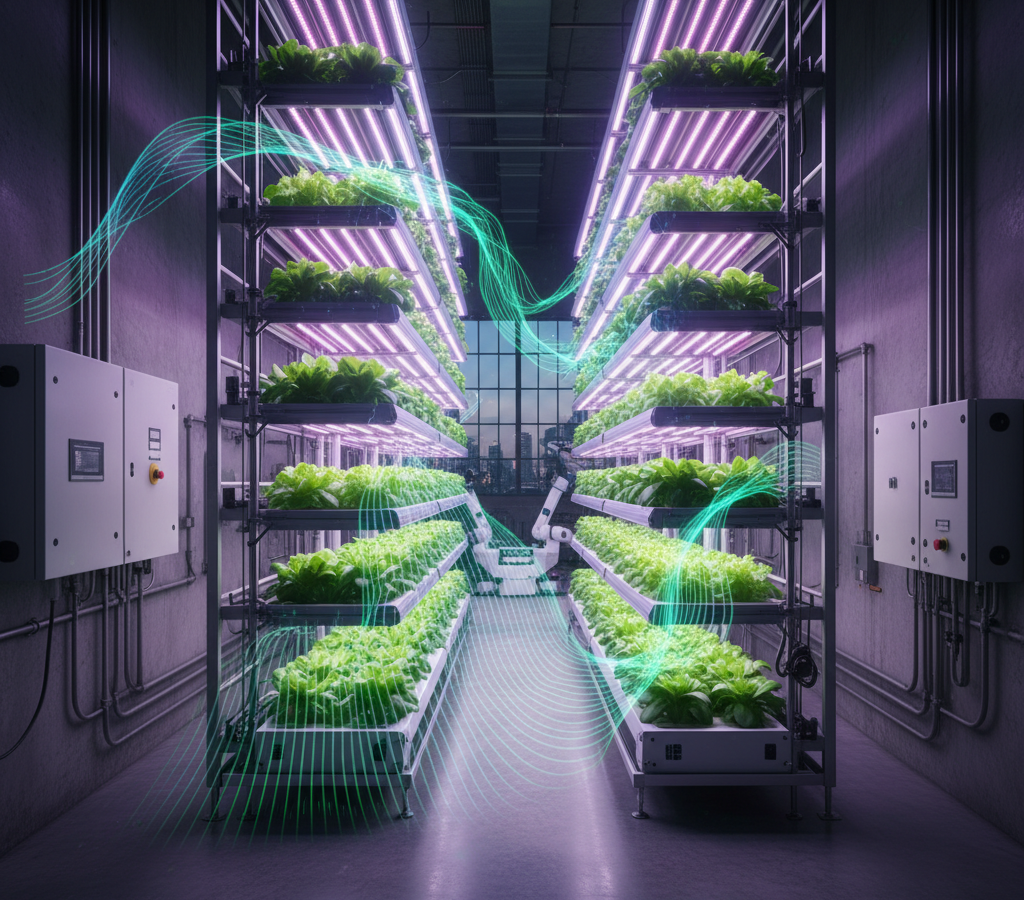
AgriLight Systems has eliminated vertical farming’s primary economic barrier: energy costs. The California-based company’s new LED arrays reduce electricity consumption by 67% while increasing crop yields by 23%, achieving total cost parity with traditional field agriculture for the first time in controlled environment agriculture history.
The Energy Challenge in Vertical Farming
Indoor vertical farms promised year-round production, 95% water savings, and elimination of agricultural runoff. However, lighting costs—representing 60-80% of operational expenses—made most operations economically unviable without subsidies or premium pricing.
Traditional vertical farms consume 38 kWh per kilogram of leafy greens produced, compared to negligible energy for field-grown crops. At average US electricity rates of $0.13/kWh, lighting alone costs $4.94/kg—exceeding wholesale prices for most vegetables.
AgriLight’s breakthrough involves matching LED spectral output to photosynthesis action spectra with unprecedented precision. Rather than broad-spectrum white light or red-blue combinations, their arrays produce eleven distinct wavelengths corresponding to chlorophyll absorption peaks.
Biomimetic Design Principles
The technology draws inspiration from forest canopy light filtering. Different plant layers in natural forests receive distinct light spectra as sunlight filters through overlying vegetation. Plants have evolved photosynthetic efficiency peaks matching these filtered spectra.
AgriLight replicates this effect by dynamically adjusting spectral composition throughout growth cycles. Seedlings receive blue-shifted light promoting compact, vegetative growth. Mature plants transition to red-shifted spectra triggering reproductive development. Harvest-stage lighting enhances nutrient density and flavor compound production.
“We’re teaching LEDs to speak the language of photosynthesis,” explains Dr. Jennifer Park, AgriLight’s Chief Technology Officer. “Every photon delivers productive work rather than waste heat.”
Performance Metrics
Field trials across 12 commercial vertical farms demonstrate consistent results:
- Energy consumption: 12.5 kWh per kilogram (67% reduction)
- Production costs: $1.87/kg including all inputs (competitive with field agriculture)
- Yield per square meter: 42 kg/year for lettuce (23% increase over previous systems)
- Crop cycle time: 21 days (reduced from 28 days)
- Nutritional content: 15% higher vitamin C, 22% higher antioxidants
The shortened crop cycles enable 17 growing cycles per year versus 12 with conventional vertical farm lighting, amplifying the energy savings through increased asset utilization.
Market Implications
Achieving cost parity transforms vertical farming from niche to mainstream agriculture. The technology removes economic barriers for crops beyond premium leafy greens, enabling commercial production of tomatoes, peppers, and strawberries—collectively a $45 billion annual market.
Major grocery retailers are responding rapidly. Walmart announced contracts for 40 vertical farms using AgriLight technology to supply 1,200 stores across the Southern US. Target and Kroger have signed letters of intent for similar deployments. These partnerships guarantee offtake agreements providing project financing certainty.
Real estate investors are repositioning urban warehouses for vertical farm conversion. Prologis, the world’s largest logistics REIT, allocated $800 million for vertical farm development in partnership with AgriLight customers. Urban retrofits eliminate transportation costs and position production within hours of consumption.
Environmental Benefits Beyond Energy
While energy efficiency enables economic viability, environmental benefits extend across multiple dimensions:
- Water usage: 95% reduction versus field agriculture (2 liters per kilogram vs 40 liters)
- Pesticide elimination: Controlled environment eliminates pesticide requirements
- Transportation emissions: Urban location reduces food miles by 92% average
- Land preservation: 97% less land area per kilogram produced
- Agricultural runoff: Complete elimination of nutrient pollution
A single urban vertical farm occupying 10,000 square meters can produce 420 tons of leafy greens annually—equivalent to 120 hectares of field agriculture. In water-stressed regions, this production uses 1.6 million fewer liters of water annually.
Scaling Challenges
Despite the breakthrough, vertical farming faces infrastructure constraints. Commercial buildings require electrical service upgrades to support 1-2 MW loads typical of large vertical farms. Utility interconnection timelines of 18-36 months delay project deployment.
Labor costs remain higher than field agriculture due to technical skill requirements. Vertical farm operators require training in LED systems, climate control, and integrated pest management—commanding wages 35% above agricultural field worker rates.
AgriLight has implemented training partnerships with community colleges in 8 states, creating certification programs for vertical farm technicians. Early graduates command $48,000-$62,000 annual salaries, creating attractive alternatives to traditional agricultural employment.
Future Applications
Beyond vegetables, AgriLight is adapting its technology for high-value crops including medicinal plants, plant-based protein crops, and ornamental flowers. Cannabis cultivation—a $28 billion industry with lighting costs exceeding 40% of operational expenses—represents an immediate adjacent market.
The company is piloting systems for rice and wheat production, potentially transforming staple crop agriculture. While economic viability remains distant for commodity grains, climate change-induced crop failures in traditional growing regions may shift the economic calculus.
AgriLight’s success demonstrates that technical innovations can overcome fundamental economic barriers preventing sustainable agriculture adoption. As energy efficiency continues improving and climate impacts intensify, controlled environment agriculture may transition from alternative to mainstream food production method.