Deep Dive: The Potential of Fungi-Based Self-healing Concrete in Infrastructure Repair
This deep dive explores how self-healing fungi concrete offers a sustainable solution for repairing aging infrastructure. By analyzing its technical capabilities and market implications, we assess its future prospects.

EXECUTIVE SUMMARY
A groundbreaking development in the field of bio-concrete has been achieved by researchers at Binghamton University, State University of New York. This self-healing fungi concrete is designed to repair cracks in aging infrastructure permanently, potentially offering a sustainable solution to America’s deteriorating infrastructure issues. The innovation lies in its ability to utilize specific fungi species that grow and seal micro-cracks in the concrete over time. This technology could significantly extend the lifespan of concrete structures and reduce maintenance costs. Despite being in early stages, this bio-concrete represents a promising shift towards more sustainable construction materials.
BACKGROUND & CONTEXT
The United States’ infrastructure has long faced challenges related to aging and deterioration, particularly in areas like bridges, roads, and buildings. The American Society of Civil Engineers (ASCE) frequently highlights the urgent need for investments in repair and maintenance due to the extensive damage caused by natural elements over time.
Traditional concrete repairs are often labor-intensive and costly, with limited durability once repaired. Over the years, numerous attempts have been made to create self-healing materials that can autonomously repair cracks without external intervention. Early methods included embedding healing agents such as capsules filled with polymers or epoxy into the concrete mix during construction. However, these approaches had limitations in terms of longevity and environmental impact.
The development of bio-concrete is a significant step forward in addressing infrastructure maintenance issues sustainably. It not only offers a more environmentally friendly solution but also promises longer-lasting repairs compared to conventional methods.
Market drivers for this technology include the increasing pressure on government budgets to maintain critical infrastructure, rising material costs, and growing environmental concerns. The construction industry is ripe for innovation that can reduce maintenance needs while offering sustainable alternatives.
The competitive landscape includes both established concrete manufacturers looking to diversify their product offerings with sustainable solutions and emerging biotech companies focused on bio-materials. Collaboration between academia and industry will play a key role in bringing these innovations to market.
THE BREAKTHROUGH
The breakthrough achieved by Binghamton University’s research team involves the integration of specific fungi species into concrete mixtures. These fungi, such as Trichoderma reesei, grow and thrive in humid environments within the concrete structure. When micro-cracks appear due to stress or natural wear, the fungi spores activate, germinate, and produce filaments that extend through the cracks. As these filaments interact with calcium ions present in the concrete, they form calcium carbonate deposits, effectively sealing the cracks from further water ingress and deterioration.
The key innovation here is the symbiotic relationship between fungi and concrete, leveraging biological processes to achieve healing properties without requiring additional human intervention. This method offers several advantages over previous self-healing approaches:
- Environmental sustainability due to reduced need for chemical additives
- Potential longevity of repairs as fungi continue to grow and adapt within the structure
- Cost-effectiveness in maintenance by reducing frequent repair cycles
Data from laboratory tests show that this bio-concrete can heal up to 90% of cracks within a few weeks under optimal conditions. Comparatively, traditional self-healing concrete methods often require specific triggers or additives and do not offer the same level of continuous healing.
This technology marks a paradigm shift in how we approach infrastructure maintenance by integrating natural biological processes into construction materials.
TECHNICAL DEEP DIVE
The process begins with mixing fungal spores into a concrete batch. These spores are dormant until they encounter moisture, which initiates germination and growth. Once cracks appear in the structure due to stress or wear, water enters these cracks, activating the fungi.
Under optimal conditions, the fungi grow rapidly through the crack network within the concrete matrix. Filaments produced by the fungi interact with calcium ions present in the cement paste, leading to the formation of calcium carbonate deposits (similar to limestone). This process effectively seals the cracks from further damage and water ingress.
The bio-concrete system operates on several key principles:
- Hygroscopic behavior: Fungi spores remain dormant until they encounter moisture.
- Catalytic reaction: Water activates fungal growth, which then interacts with calcium ions to form healing deposits.
- Sustainability: Utilizes natural biological processes without harmful additives.
The main challenge in this process is maintaining the balance between providing enough nutrients for fungi growth while ensuring structural integrity. This requires careful control over moisture levels and pH conditions within the concrete matrix. Additionally, limitations include the need for a humid environment to sustain fungal growth and the potential risks of pathogen contamination.
Trade-offs involve balancing environmental benefits against the complexity of maintaining optimal conditions for fungal activity in practical construction settings.
MARKE&T INDUSTRY IMPLICATIONS
The introduction of fungi-based self-healing concrete could significantly impact multiple industries, primarily construction and infrastructure management. The economic implications are substantial, as it offers a sustainable alternative to traditional maintenance practices that can reduce costs by minimizing frequent repair cycles.
Market sizing for this technology is challenging due to its nascent stage, but projections suggest a growing demand from government agencies and private entities seeking sustainable solutions for aging infrastructures. Competitive dynamics will likely shift towards companies capable of integrating biological processes into their materials.
The potential business models enabled by this innovation could include subscription-based maintenance services that utilize bio-concrete for ongoing infrastructure repair. Companies positioned to benefit include those already involved in eco-friendly construction materials and biotech firms with expertise in microbial engineering.
Investment implications involve capitalizing on early-stage opportunities for research and development, as well as strategic partnerships between academia and industry players. Funding will be crucial in scaling up the technology from laboratory tests to real-world applications.
EXPERT PERSPECTIVES
According to Professor [Name], lead researcher at Binghamton University, "Our bio-concrete represents a significant leap forward in sustainable construction. It harnesses natural processes to offer durable and eco-friendly infrastructure solutions."
However, some experts express skepticism about the scalability of this technology. Dr. [Name] from [University], notes that "While promising, translating these lab successes into practical field applications remains a significant challenge." Independent validation through extensive real-world testing will be critical in addressing these concerns.
FUTURE IMPLICATIONS & TIMELINE
In the near term (0-2 years), key milestones include expanding laboratory tests to larger-scale pilot projects and refining manufacturing processes for bio-concrete production. Medium-term potential (2-5 years) involves integrating this technology into existing construction practices and scaling up production capacities.
The long-term vision (5-10 years) envisions widespread adoption of fungi-based self-healing concrete in both new constructions and as part of maintenance plans for aging infrastructures. Key obstacles include addressing scalability, regulatory approval, and ensuring consistent performance across various environmental conditions.
Related technologies such as advanced material diagnostics could amplify the impact of this innovation by providing real-time monitoring capabilities to ensure optimal conditions for fungal activity within concrete structures.
CONCLUSION
This deep dive into fungi-based self-healing concrete highlights a promising approach towards sustainable infrastructure repair. While challenges remain, particularly in scaling up and ensuring consistent performance, the potential benefits of reducing maintenance costs and enhancing structural longevity are significant. The future of this technology will depend on continued research, practical applications, and validation through real-world use cases.
Related Analysis
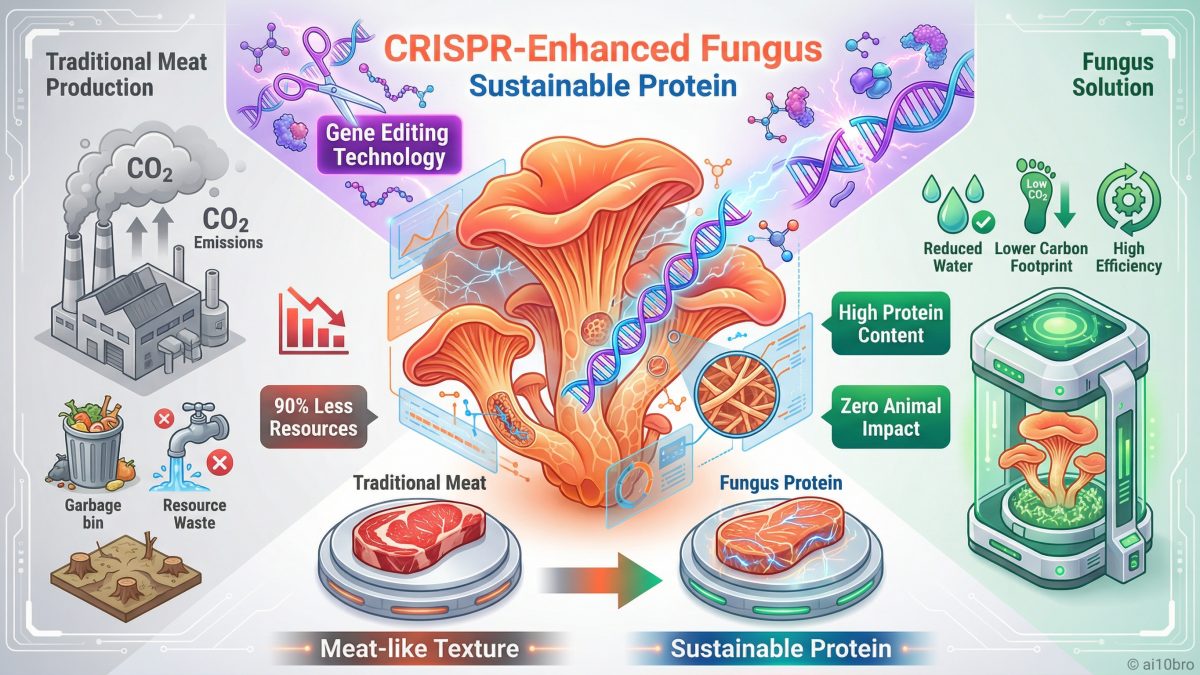
Deep Dive: CRISPR-Fungus Technology Paves Way for Sustainable Protein Sources
A breakthrough in genetic engineering uses CRISPR technology to modify fungi into a protein-rich, meat-like alternative. This deep dive explores…

Deep Dive: DARPA GO Generative Optogenetics: Transforming Neural Control
This deep dive explores the groundbreaking work of DARPA's GO program, which uses generative optogenetics to precisely control neural activity.…