Dynamic Pheromone Control Boosts Cordycepin Production in Cordyceps militaris
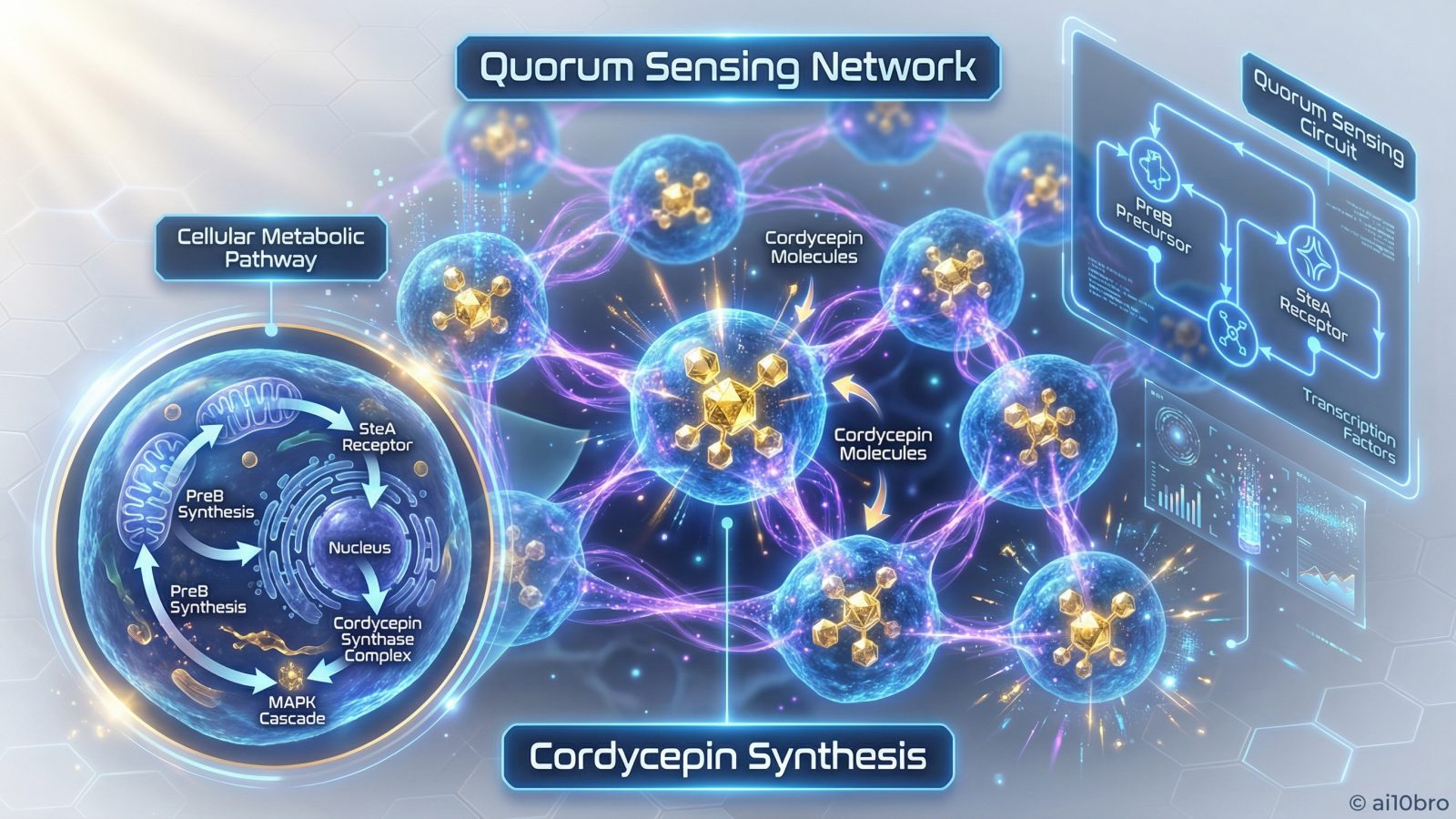
Hook: Scientists have developed an innovative method to dynamically regulate the production of cordycepin using pheromones in Cordyceps militaris, a breakthrough that could significantly enhance the efficiency and yield of this valuable compound.
Overview
The research team, led by Qingyang Zhang at an undisclosed institution, has unveiled a groundbreaking technique to control the biosynthesis of cordycepin in Cordyceps militaris. By reconstructing a pheromone-mediated quorum sensing (QS) system within these fungi, the researchers have achieved signal-responsive regulation of cordycepin production. This new method offers precise modulation while maintaining cell growth, thereby overcoming limitations associated with static control mechanisms.
Context and Significance
This achievement is significant for both scientific research and pharmaceutical applications. Cordycepin has broad pharmacological activities and is under investigation for its potential in treating various diseases, including cancer and cardiovascular disorders. By enhancing the precision of cordycepin biosynthesis, this technique could reduce production costs and increase yields, potentially revolutionizing the $2 billion global market for medicinal mushrooms by 2030.
The breakthrough also ties into broader trends in synthetic biology and bio-innovation, where precise genetic control is key to developing sustainable and efficient bioproduction systems. This work overcomes previous limitations of static regulation methods that often led to suboptimal yields or compromised cell health.
How It Works
The pheromone-mediated QS system in Cordyceps militaris leverages phylogenetic and conserved domain analyses, demonstrating structural homology between the pheromone receptor PreB and transcription factor SteA with those found in Saccharomyces cerevisiae. This homology supports functional compatibility across species. The synthetic circuit consists of an α-pheromone (mfα1) and a pheromone-responsive promoter.
Technical Details
The system operates by responding to environmental signals, allowing dynamic adjustments in cordycepin biosynthesis based on the colony’s density or other conditions. This approach offers several advantages over previous methods:
- Precision Control: The pheromone system enables precise regulation of biosynthetic pathways.
- Maintaining Cell Growth: By not compromising cell growth, this method ensures sustained productivity.
Real-World Applications
The technology has immediate applications in biopharmaceutical and nutraceutical industries. Companies specializing in the cultivation of medicinal mushrooms can adopt this technique to improve their production processes. The economic implications are substantial, as cost savings through increased efficiency could make cordycepin more accessible for widespread medical use.
What’s Next
The next steps involve scaling up the technology from lab-scale operations to commercial production levels. Researchers aim to optimize the pheromone system further and explore additional applications of quorum sensing in other medicinal fungi. Key milestones include piloting the technique in industrial settings and achieving regulatory approval for pharmaceutical use.
Obstacles
The main challenge lies in ensuring consistent performance across different environmental conditions and scaling up without losing control precision. Nonetheless, this breakthrough marks significant progress toward more efficient bio-manufacturing processes within the synthetic biology sector.
Related Insights

Engineers Unveil New Principles for lncRNA-Based Epigenetic Regulation
Researchers derive engineering principles for designing long non-coding RNAs to control chromatin states, opening new pathways in biomedical applications.

Bioengineering Advances Tendon Repair with Dermal Fibroblasts
Researchers from the European Union have made a breakthrough in bioengineering that could revolutionize tendon repair by directing dermal fibroblasts…

Modular Metabolite-Controlled Gene Expression Systems Developed
A new system allows precise control over gene expression through metabolites, offering a major leap in synthetic biology.